
Know the required project structure.
Use this guide as a quick reference for the project structure, chapter headings and formatting requirements supplied for Science Education students.
Request formatting support →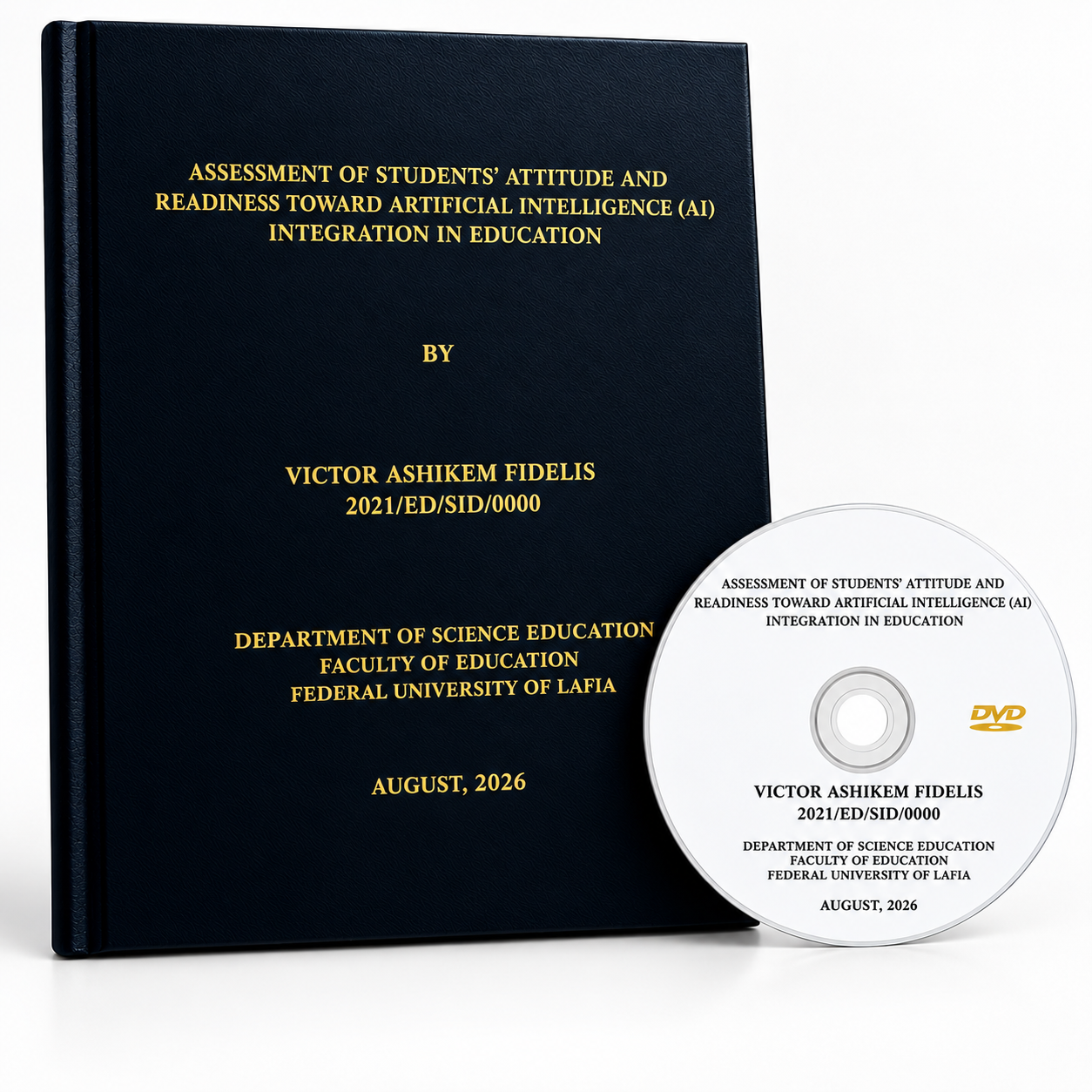 Binding sample
Department-style bound copy
This sample shows the dark-bound project presentation style used in the department. Students should follow the current departmental instruction for their final printing and binding.
The project title should contain no more than 23 words.
Use A4 paper with equal 1-inch margins.
Use Times New Roman, font size 12 throughout the report.
Type the body of the report using double line spacing and justify the text.
References and citations should follow APA 7th edition, with current literature and careful attention to plagiarism.
Important: These notes are presented from the project research guideline supplied to SEPC. Departmental requirements can be updated, so students should confirm any new instruction before final submission.
00Preliminary PagesCover page, title page, declaration, certification, dedication, acknowledgement, contents, lists and abstract.
Order
- Cover Page
- Title Page
- Declaration
- Certification
- Dedication
- Acknowledgement
- Table of Contents
- List of Tables
- List of Figures (if any)
- Abstract
Abstract
The abstract should read like a mini-paper and contain, in order:
- Main purpose of the study
- Methods and techniques used
- Major findings/results
- Recommendations
01Chapter One — IntroductionBackground, problem, objectives, questions/hypotheses, significance, scope and operational definitions.
The background should move from the broad topic to the specific research context, showing the need and rationale for the study in a convincing funnel structure.
02Chapter Two — Review of Related LiteratureConceptual framework, theoretical framework, empirical studies and summary of reviewed literature.
Begin with an introductory statement that explains what the chapter covers and names the major sub-headings.
Conceptual Framework
Present the conceptual model and explain the linkages among the variables or concepts of the study.
Theoretical Framework
Review the major theory or theories related to the topic and explain their relevance to the study.
Empirical Studies
Review related studies by indicating purpose, sample and sampling technique, instruments, analysis method and major findings. Use relevant sub-headings.
Summary
Summarize the literature and clearly indicate the gap that justifies the present study.
03Chapter Three — Research MethodologyDesign, area, population, sample, instruments, validity, reliability, data collection and data analysis.
State the procedures followed in carrying out the study under the relevant methodology sub-headings.
Research Design
State the design and justify why it is appropriate for the study.
Population & Sample
Define the population to which findings will be generalized, give the sample size, sampling technique and justification.
Instrument
Describe instruments such as questionnaires, interviews, rating scales, tests or documents, including sections, response scales and weightings.
Validity & Reliability
Explain the validation process and the chosen reliability method, how it was conducted and the result obtained.
Data Collection
Describe step by step how the instruments were administered and how the data were collected.
Data Analysis
State and justify the statistical tools used, such as frequencies, percentages, mean, standard deviation, chi-square, t-test, ANOVA and suitable charts/graphs.
04Chapter Four — Presentation and Data AnalysesPresent findings systematically using tables and figures, following research questions and hypotheses.
Start the results section with an introductory statement explaining that the results are presented in accordance with the research questions and hypotheses.
Number tables in order of occurrence. Refer to them in the text using phrases such as “see Table 2” or “as shown in Table 2”, rather than “the table below” or “the table above”.
05Chapter Five — Discussion, Conclusion and RecommendationsDiscussion, implications, conclusion, recommendations, limitations and suggestions for further study.
Discussion of Findings
For each major finding: (1) state the finding, (2) explain how it agrees or disagrees with previous research, and (3) justify why your finding may agree or disagree with earlier work.
Implications
Describe the practical implications and contribution of the study to the field.
Recommendations
Recommendations should flow directly from the study findings.
Limitations
Point out major material or human factors that affected the timely completion of the study.
Further Study
Identify possible dimensions or related questions that future researchers could address.
RReferences & AppendicesAPA 7th edition, contemporary sources, citation integrity and required appendix documents.
References
- Use APA 7th edition strictly.
- Cite all literature, illustrations and figures used.
- Use contemporary literature where appropriate.
- Students should be conscious of plagiarism and maintain proper citation practices.
Appendices — order of arrangement
- Letter of Introduction from Head of Department to the field
- Letter of Attestation from the field / study location
- Instruments / Packages
 Join WhatsApp Group